EMG Signal

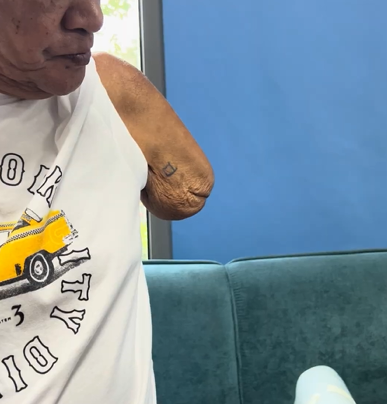
A close-up side profile of an elderly individual with an upper-limb amputation above the elbow. The residual limb shows visible skin wrinkling and signs of muscle atrophy. A small, simple square tattoo is visible on the side of the limb.

When Muscles Change: How Vulcan Supports Patients With Muscle Atrophy and Long-Term Limb Loss

One of the less-discussed challenges in upperlimb prosthetic care is what happens to muscle tissue over time and what that means for myoelectric control. For many patients, the residual limb doesn’t stay the same after amputation. Muscles that aren’t regularly activated begin to atrophy. Fatty and fibrous tissue accumulates. The signals that a prosthetic system needs to read become quieter, less stable, and harder to interpret. In some long-term cases or congenital presentations, those signals may be extremely faint from the outset. Traditional electrode systems weren’t designed with this in mind and for a significant portion of the prosthetic population, that’s a real limitation. What Happens to EMG Signals as Muscles Atrophy Following amputation, the residual limb goes through a prolonged process of biological change. The most significant shifts typically occur in the first 6 to 18 months, but remodeling can continue indefinitely particularly in patients who don’t use a prosthesis early or who have limited physical activity. These changes affect EMG signal quality in several ways: Signals become less stable Atrophied muscle has fewer active motor units firing in a coordinated way. The result is a signal that fluctuates, making it difficult for patients to maintain a consistent contraction and for the system to interpret intent accurately Tissue changes increase impedance As fatty and fibrous tissue accumulates between the muscle and the electrode, signal conduction attenuates. Electrode contact becomes less consistent, particularly as limb shape continues to change. Noise becomes a bigger problem When signal amplitude is low, the ratio of useful signal to background noise deteriorates. Crosstalk from adjacent muscle groups increases, and the risk of the system misreading a signal or missing one entirely goes up. Why Conventional Electrode Systems Fall Short Traditional dual-electrode setups depend on two things: accurate placement over a defined motor point, and signals strong enough to reliably cross a fixed threshold. In a healthy, recently-fitted patient, that’s a reasonable assumption. In a patient with significant atrophy, neither condition may hold. Motor points may no longer be clearly defined. Signals may never consistently reach the threshold needed to trigger a command. The system that worked at fitting may become unreliable months later as the limb continues to change. For long-term amputees, non-users returning to prosthetic care, or individuals with congenital limb differences, this creates a meaningful barrier to myoelectric control — not because the patient can’t generate signals, but because the system can’t detect and interpret the ones they have. How Vulcan Approaches It Differently Rather than requiring a strong signal from a fixed location, the Vulcan Myoband is designed to work with what’s available and to find it across the full residual limb. Vulcan Myoband encircles the limb with multiple sensors. If one area is atrophied or fibrotic, the system scans across all sensor sites and prioritizes data from wherever the most active muscle tissue remains. This spatial flexibility means the system isn’t dependent on a single motor point holding up over time. Pattern recognition over amplitude thresholds Conventional systems operate on a simple rule: if the signal exceeds a set value, trigger a command. For patients with weak signals, that threshold may never be consistently reachable. The Vulcan system learns the shape of each patient’s signal rather than just its amplitude. This shifts the control logic from “how strong is the signal” to “what does this signal mean for this patient.” Micro-activation detection and spatial mapping Advanced noise filtering allows the system to detect very small muscle activations that would be invisible to conventional electrodes. Spatial mapping builds a distribution picture of activity across the residual limb, helping clinicians identify the most viable muscle sites to target during training, even in complex or long-term cases. A Three-Step Clinical Protocol for Atrophy Cases For patients with muscle weakness or long-term limb loss, Vulcan’s approach follows a structured sequence: 1. Calibration The Vulcan app learns the patient’s current contraction levels during initial setup — even if those contractions are extremely faint. Rather than requiring the patient to meet a fixed standard, the system adapts its baseline to where the patient actually is. 2. Visual feedback The patient can see their muscle activity in real time on screen. This isn’t just reassuring, it’s clinically meaningful. Visual feedback helps the brain reconnect with and learn to control muscles that may have had limited use for months or years, supporting the neuromuscular re-engagement that underpins effective prosthetic training. 3. Physical conditioning Alongside device training, daily massage and isometric exercises help maintain remaining muscle fiber density and improve local blood flow. Preserving what muscle tissue remains makes a measurable difference to long-term signal quality and control consistency. Why This Matters for Clinical Practice Muscle atrophy is not a niche presentation. It affects long-term amputees, late fitters, patients who’ve had previous prosthetic abandonment, and individuals with congenital limb differences. It’s also a progressive condition, meaning patients who are well-controlled at fitting may become harder to manage over time if the system can’t adapt. A control approach that reads signal patterns rather than raw amplitude, captures data across the full limb rather than fixed points, and adapts its baseline to the individual patient is better positioned to serve this population both at the point of fitting and across the years that follow.
When Muscles Change: How Vulcan Supports Patients With Muscle Atrophy and Long-Term Limb Loss Read More »

Adaptive Threshold Control: How Vulcan Keeps Prosthetic Response Consistent in Daily Life

The idea behind traditional myoelectric threshold control is simple. A lower muscle contraction opens the hand. A stronger one closes it. Clinicians set the levels, patients learn the pattern, and it works at least in the clinic. The issue is that muscle signals don’t stay consistent once the patient leaves. Why EMG Signals Don’t Stay Consistent The difficulty isn’t the threshold method itself. It’s that EMG signals naturally vary with fatigue, posture, and electrode contact. Static thresholds have no way to account for that variation. A calibration that feels stable in the clinic can behave differently at home, not because anything was set up incorrectly, but because the signal environment has changed. For clinicians, this often means repeated adjustments at follow up. For patients, it can mean a device that feels less predictable than expected, which over time affects confidence and daily use. How Vulcan Handles It Differently Vulcan keeps the same basic threshold logic — lower activation for one action, higher for another — because it works and patients understand it. What changes is that the thresholds aren’t fixed. The Myoband combines multi-channel EMG sensing with an integrated IMU that tracks arm movement in real time. Using both signals together, the control algorithm adjusts thresholds dynamically based on what the arm is actually doing at any given moment. When someone lifts their arm to reach for something, their muscles naturally tighten to stabilize the limb. A static system may read that as a potential command. Vulcan reads it as posture, and holds back. When the arm is relaxed and a deliberate contraction comes through, the system recognizes it as intentional and responds. Same threshold logic patients are already familiar with, one that adapts to real conditions rather than assuming they stay constant. What the Data Tells Clinicians Over Time Because the system logs threshold values during calibration and regular use, clinicians build a picture of how each patient’s muscle performance changes over time. Are activation levels becoming more consistent? Is the patient needing to contract harder than before? That kind of longitudinal insight is difficult to get from a conventional setup, where threshold changes happen by feel and little gets recorded systematically. Having it available makes follow-up conversations more grounded and gives rehabilitation teams something concrete to work from when planning training adjustments. What It Means in Practice For patients: Day-to-day control feels more predictable. Fewer unexpected hand movements, less frustration when the device doesn’t respond as expected. The learning curve stays manageable because the underlying logic doesn’t change, it just holds up better under real conditions. For clinicians and CPOs: The calibration process stays familiar. The difference is fewer return visits for threshold tweaks, and more confidence that settings will hold between appointments. For rehabilitation teams Longitudinal signal data adds a layer of objectivity to recovery tracking that conventional systems don’t easily provide. Learn more about Vulcan

Adaptive Threshold Control: How Vulcan Keeps Prosthetic Response Consistent in Daily Life Read More »

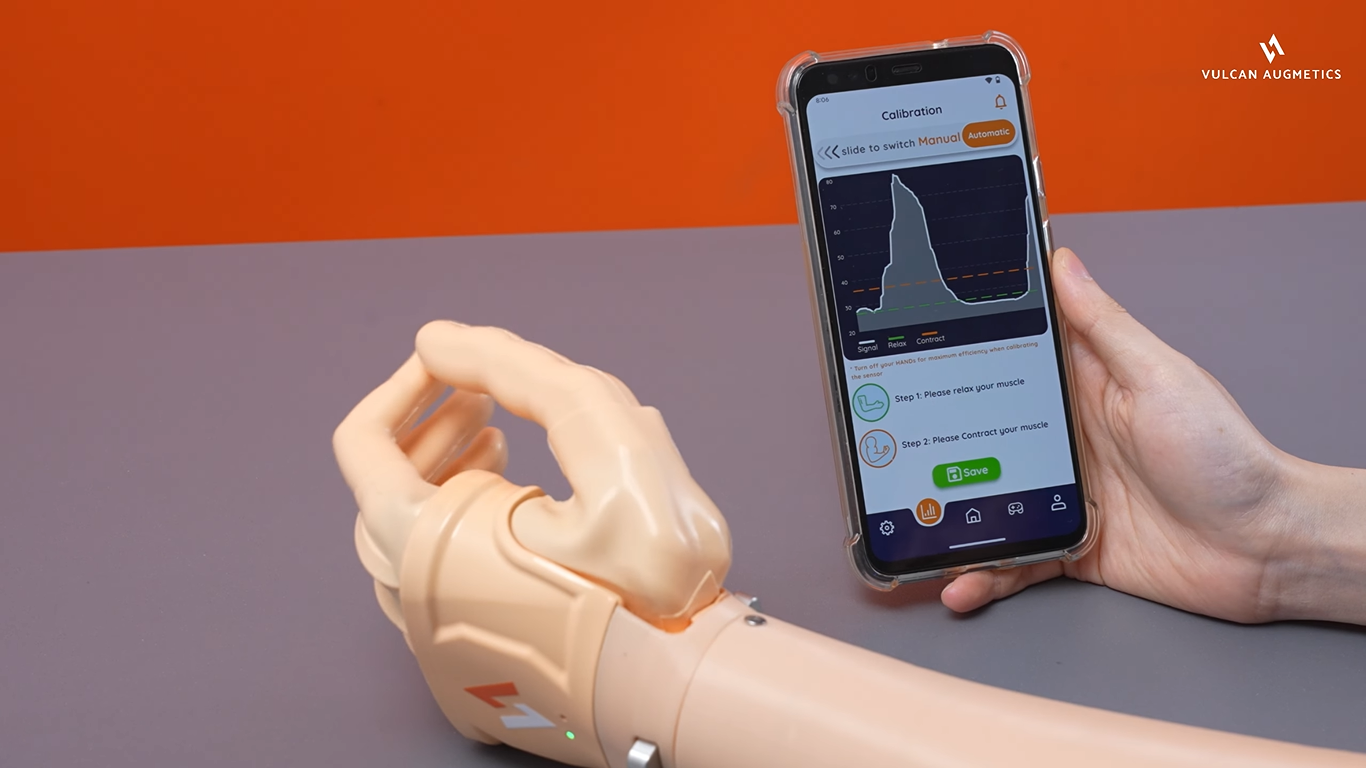
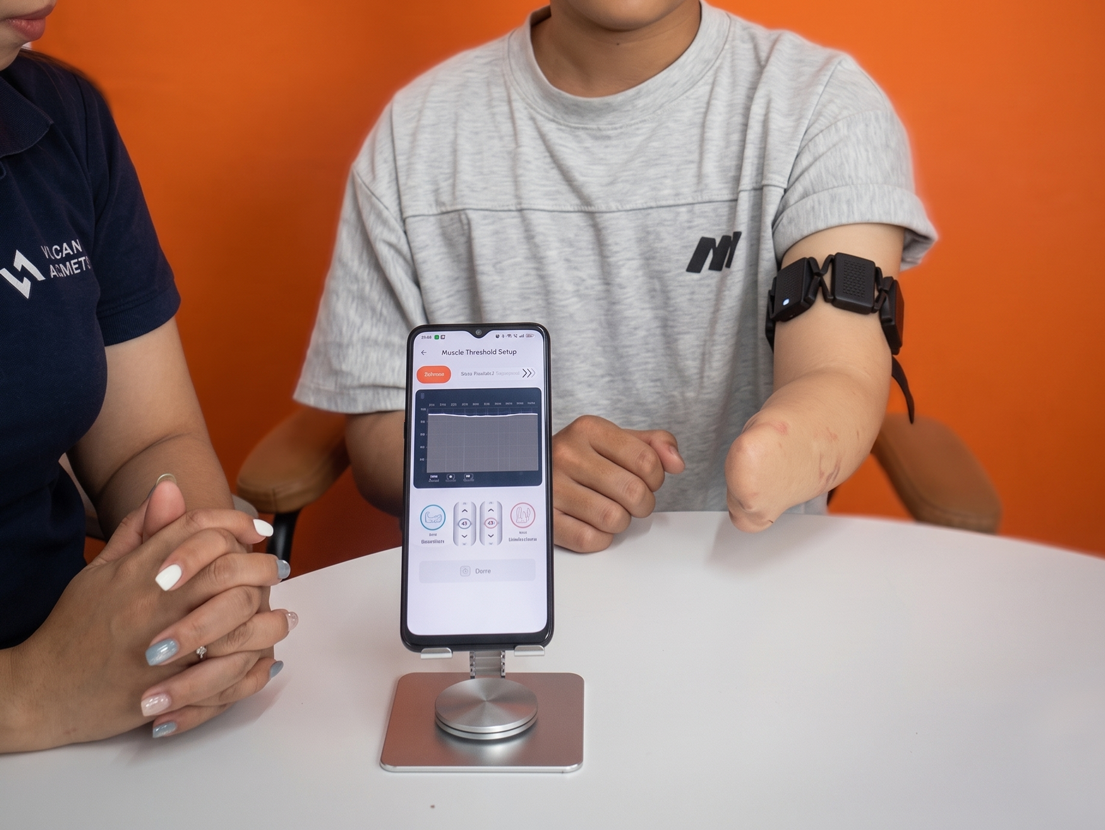
A clinician and a patient with a transradial amputation evaluating real-time EMG signals. The patient wears a Vulcan wireless myoband on the residual limb, while a smartphone on a stand displays a visual graph of muscle activation thresholds.

Real-Time EMG and IMU Visualization in Prosthetic Care: How the Vulcan App Supports Clinical Decision-Making

Accurate muscle signal assessment sits at the heart of upper-limb prosthetic care. From the very first myoelectric evaluation through to electrode placement, socket fitting, calibration, and long-term rehabilitation follow-up, clinicians depend on signal quality to make informed decisions at every stage. Yet in many clinicians today, that assessment still relies heavily on observation, experience, and subjective interpretation with limited access to measurable, real-time data. The Challenge: Limited Signal Visibility in Clinical Settings Surface EMG signals are inherently small and variable. They shift with limb position, tissue characteristics, socket fit, and muscle fatigue. When clinicians lack reliable, visible signal data, the consequences ripple across the entire care pathway: These gaps extend fitting timelines, reduce patient confidence, and can limit long-term prosthetic adoption. Real-Time Signal Visualization with the Vulcan Myoband The Vulcan Myoband addresses this directly by streaming real-time EMG and inertial motion (IMU) data through the Vulcan mobile app by putting objective signal information in the hands of both clinicians and patients during every stage of care. Worn as a sensor band around the residual limb, the Myoband captures muscle activation patterns, contraction timing, and arm movement dynamics simultaneously. Proprietary signal-processing algorithms convert raw biosignals into clear visual feedback, and the system automatically calculates and establishes activation thresholds calibrated to each individual’s muscle strength. The result is a dual-purpose interface designed for both clinical depth and patient clarity: This visual feedback loop supports a well-established principle in motor rehabilitation: when patients can see their muscle activity in real time, the brain reconnects with and learns to control those muscles more effectively. Clinical Applications and Benefits Real-time EMG and IMU visualization through the Vulcan app supports more informed, efficient prosthetic care across five key areas: 1. Objective myoelectric assessment Before a socket is even fabricated, clinicians can use the Myoband to verify whether a patient can generate stable, consistent muscle signals. This supports earlier and more confident prosthetic prescription decisions — reducing the risk of misclassifying candidates as unsuitable for myoelectric control. 2. Streamlined clinical workflow Signal capture, threshold visualization, and contraction analysis are all built into a single app. Clinics can conduct muscle assessments without investing in separate EMG diagnostic tools, reducing setup time and improving overall appointment efficiency. 3. Evidence-based calibration Visual feedback on contraction strength and response speed allows precise adjustment of threshold levels and control sensitivity. Clinicians can identify and minimize excessive muscle exertion, a common contributor to fatigue and long-term abandonment, with measurable data rather than subjective judgment. 4. Data-driven rehabilitation Stored signal and motion metrics can be reviewed over time, allowing therapists to track muscle activation trends, monitor recovery milestones, and adjust training plans based on objective progress data rather than recall alone. 5.Outcome measurement and reporting Quantitative biosignal data provides structured, reproducible metrics that contribute to clinical reporting and formal outcome assessments — supporting both individual patient care and broader service evaluation. From Experience-Based to Evidence-Based Prosthetic Fitting By making biosignal information visible, measurable, and shareable, the Vulcan ecosystem helps shift prosthetic fitting from a largely experience-dependent process toward a more data-guided clinical workflow. Real-time EMG and motion visualization gives patients a clearer understanding of their own control strategies, accelerates training, and builds the kind of long-term confidence that drives consistent prosthetic use. Learn more about Vulcan →

Real-Time EMG and IMU Visualization in Prosthetic Care: How the Vulcan App Supports Clinical Decision-Making Read More »

What is Vulcan Myoband? How the Myoband Controls the Vulcan Myoelectric Hand

The Vulcan Myoband is a wearable biosignal sensor designed to detect electromyographic (EMG) signals generated when muscles contract. These signals are then used to control a myoelectric or bionic prosthetic hand through Bluetooth Low Energy (BLE). In simple terms, the Myoband acts as the control interface between the patient’s muscles and the prosthetic hand, translating muscle activity into movement. Unlike traditional prosthetic systems that place electrodes inside the socket, the Myoband is worn as a sensor band around the upper arm, typically over the biceps. This design allows the system to capture muscle signals without relying on precise electrode placement within the prosthetic socket. How Does It Work for Patients? 1. Detecting Muscle Signals When a patient attempts to move their missing hand, the remaining muscles in the arm still generate EMG signals. The Myoband contains EMG sensors + IMU sensor positioned around the arm to detect muscle activity from different areas. This multi-point sensing approach helps the system capture weak or complex signals that may be difficult to detect with conventional electrode setups. Watch Video: See How the Vulcan Hand Calibrates in Under 1 Minute! 2. Processing the Biosignals The Vulcan system uses a threshold-based signal detection method. During calibration which typically takes less than one minute, the system analyzes the patient’s EMG signals and automatically determines two key levels: the muscle contraction threshold and the muscle relaxation threshold.  The Myoband’s built-in system automatically measures and analyzes patient EMG signals, calculating and establishing activation thresholds that adapt to each individual’s muscle strength, even in patients with weak or variable EMG signals. 3. Translating Signals Into Movement After calibration, the Vulcan prosthetic hand responds directly to the patient’s muscle activity through BLE communication. In the Vulcan system, the Myoband functions as the signal acquisition and processing unit, while the prosthetic hand acts as the execution device. After muscle activity is detected and translated into control commands, the Myoband sends these commands wirelessly to the prosthetic hand in real time. For example: Depending on the configuration, the control logic can also be reversed. This wireless control solution removes the need for complex internal wiring inside the prosthetic socket. As a result, clinicians have greater flexibility during socket fabrication, while patients benefit from a lighter system, easier maintenance, and more stable signal transmission during daily movement. Contact our clinical team today to see if the Vulcan system is right for you. Click Here How to Wear the Myoband Proper Placement Place the Myoband around the upper arm or forearm, positioning the sensors over the muscles used for control. Adjusting the Strap Wrap the adjustable strap around the arm and secure it comfortably. The band should fit snugly but not too tight. Skin Preparation For optimal signal detection, make sure the skin is clean and dry before wearing the Myoband. Avoid lotions or oils that may affect signal quality. Electrode Preparation Before use, ensure the electrode surfaces are clean. Wipe them with a dry, lint-free cloth to remove dust or residue that could interfere with signal detection. [Watch the User Video Here]

What is Vulcan Myoband? How the Myoband Controls the Vulcan Myoelectric Hand Read More »

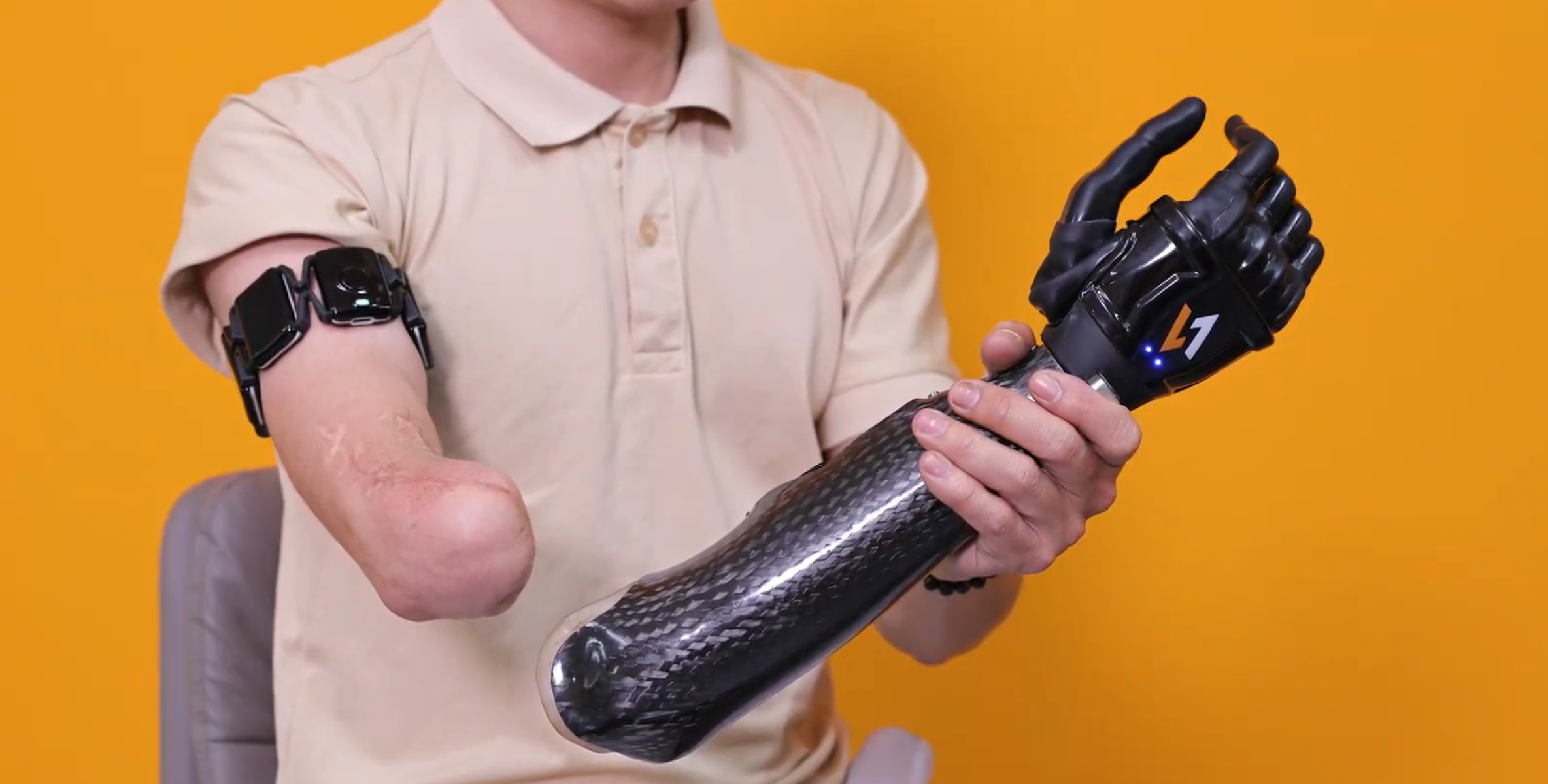
A person with a below-the-elbow amputation wearing the Vulcan Myoband—a black, segmented multi-sensor armband—on their upper arm. They are holding a sleek, carbon-fiber prosthetic hand (marked with the 'V1' logo) to demonstrate the connection between the sensors and the device against a bright yellow background.

Optimizing Myoelectric Hand Control: How the Vulcan Myoband Overcomes Clinical Fitting Challenges

After an upper-limb amputation, receiving a myoelectric prosthetic hand can take one to six months, even after insurance approval or out-of-pocket agreement. The fitting process alone typically requires three to four clinic visits, depending on the complexity of the limb condition and the fabrication workflow. Yet despite this time and effort, myoelectric fittings still fail in many clinics. So why does fitting still take so long? Several factors commonly slow down the process: The EMG Signal Challenge Myoelectric prosthetic control relies on electromyographic (EMG) signals, which are generated when residual muscles contract. After an upperlimb amputation, the remaining muscles in the forearm or upper arm can still produce these signals when a patient attempts to move the missing limb. However, the characteristics of these signals vary widely from patient to patient. The biology of the residual limb and the original surgical procedure play a major role in determining how usable these signals are for prosthetic control. Several factors influence EMG signal quality, including: In addition, surgical reconstruction can alter the natural structure of the muscle system. Depending on the procedure, residual muscles may be reattached to bone or tendon, which can change how neuromuscular signals are generated and transmitted. As a result, EMG signals in an amputated limb often differ from those in an intact limb. They typically show: Surface EMG sensors must detect these signals through several biological layers, including muscle tissue, connective tissue, subcutaneous fat, and skin, which further attenuate and filter the electrical activity. Because of these physiological factors, sensor placement becomes critical. Clinicians must identify the most active muscle regions and optimize electrode placement based on signal amplitude, soft tissue thickness, and stability within the prosthetic socket. Why Electrode Placement Is So Difficult Most traditional myoelectric systems requiring electrodes to be placed on two opposing muscle groups. For reliable detection, electrodes must be positioned precisely on the muscle belly and aligned with the direction of the muscle fibers. During fitting, prosthetists often ask patients to perform repeated muscle contractions while adjusting electrode locations to find signals that are both strong and distinguishable. In practice, this process can involve extensive repositioning and testing, sometimes referred to clinically as “myosite hunting.” Even when optimal placement is achieved in the clinic, maintaining stable signals in daily life remains challenging. Factors such as electrode displacement, socket pressure changes, sweat, and natural biological changes in the residual limb can all affect signal quality. Socket Limitations In conventional prosthetic systems, electrodes are typically embedded inside the socket, which creates additional constraints. Socket design must balance structural strength, comfort, and space for electronic components. At the same time, electrode locations become fixed once the socket is fabricated. However, residual limb volume can fluctuate throughout the day, and small shifts in socket position during daily movement can alter electrode alignment. When signal quality changes, patients may require re-adjustments or even a new socket, extending the fitting timeline and sometimes leading to frustration or abandonment of the prosthesis. The Result: A Trial-and-Error Process Because EMG signals vary between individuals and depend heavily on precise electrode placement, the fitting process often becomes iterative and time-consuming. Multiple adjustments, test fittings, and recalibrations may be needed before achieving stable control. For patients eager to regain independence, these delays can be discouraging. For clinicians, they represent one of the most persistent challenges in modern myoelectric prosthetic care. How the Vulcan Myoband Addresses Common EMG Signal Detection Challenges Reliable EMG signal detection remains one of the most common challenges in myoelectric prosthetic control. In clinical practice, obtaining stable signals can be difficult, especially for patients with complex residual limb conditions. Supporting Patients With Weak or Complex EMG Signals The challenge: Many patients struggle to produce strong, clearly separated EMG signals due to factors such as: The Vulcan Solution: Instead of requiring strong or highly isolated contractions, the Myoband detects subtle increases in muscle activation above the resting state to establish basic open-close control of the prosthetic hand, based on a threshold recognition technology. As a result, patients may experience: Scar tissue, thick subcutaneous fat, or skin grafts, common in burn or trauma patients, can weaken EMG signals, making it difficult to identify two reliable muscle sites for traditional dual-electrode control on the residual limb. The Myoband overcomes this by being worn around the upper arm and using multiple sensors to capture overall muscle activation across a wider area. Even if one region produces weaker muscle signals due to scarring or reduced sensitivity, the system can still detect activity from surrounding healthy muscle tissue. Reduced Dependence on Precise Electrode Placement The Challenge: Traditional myoelectric systems often require precise electrode placement over specific muscle sites. Small positional changes can significantly affect signal quality. The Vulcan Solution: The Myoband reduces this dependency through multi-channel EMG sensing distributed around the upper arm, capturing signals from several muscle regions simultaneously. This design offers several practical advantages: Stability During Daily Movement The Challenge: During everyday activities, prosthetic sockets may shift slightly on the residual limb, a phenomenon known as pistoning. When electrodes are embedded inside the socket, this movement can disrupt signal detection. The Vulcan Solution: Because the Myoband is worn directly on the arm, the sensors maintain more stable contact with the skin.  The Myoband also integrates an IMU (Inertial Measurement Unit) that detects arm position and orientation. This helps distinguish between intentional muscle activation and postural contractions. For example: The system is also designed to handle environmental factors such as sweat and changes in skin impedance, using adaptive algorithms that maintain stable activation thresholds and reduce unintended hand movements.

Optimizing Myoelectric Hand Control: How the Vulcan Myoband Overcomes Clinical Fitting Challenges Read More »