
A practical introduction to EMG-based control for prosthetic hands, wrists, and elbows.
What is a myoelectric prosthesis?
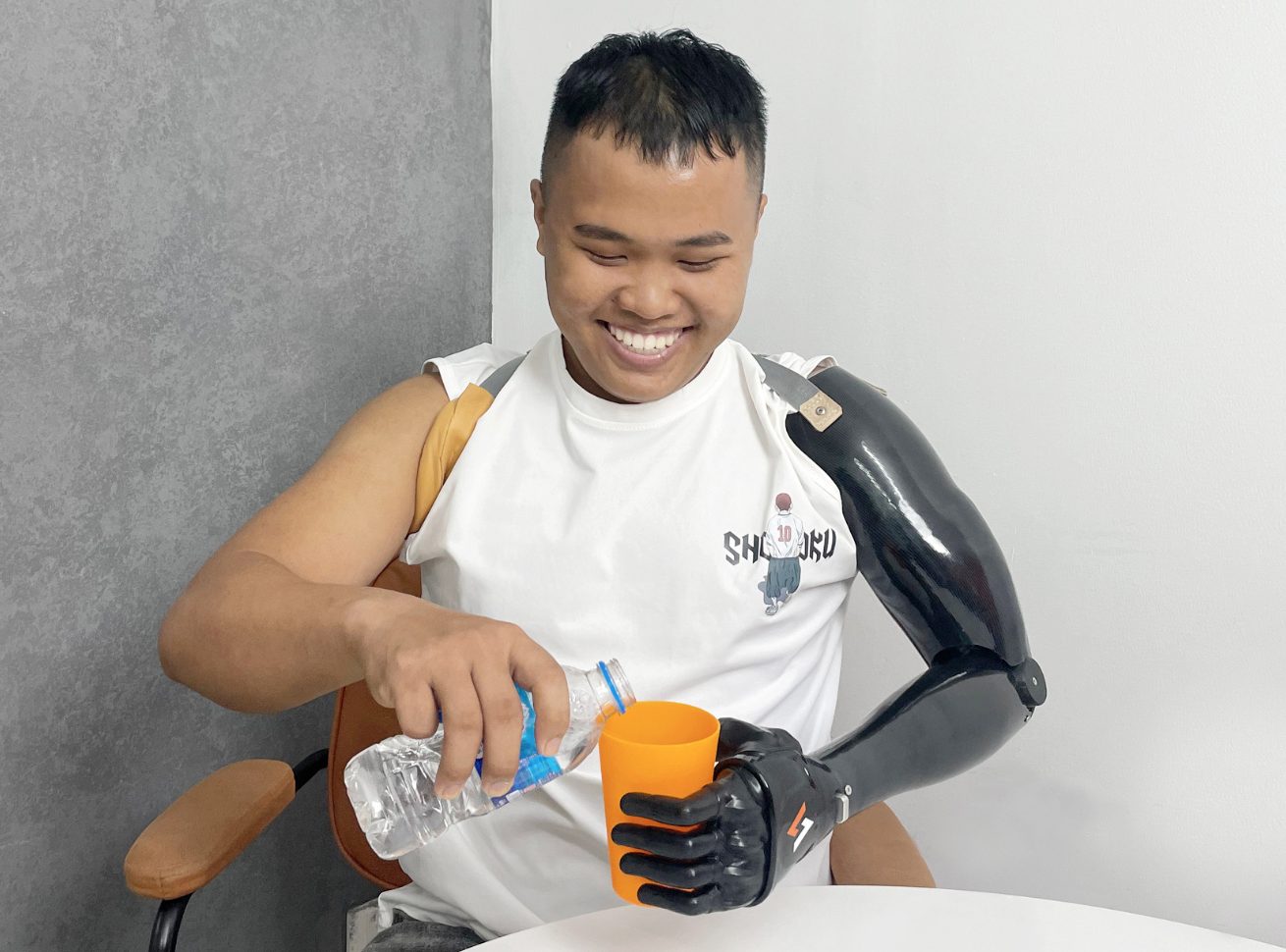
A myoelectric prosthesis is an externally powered artificial limb that uses electrical signals produced by muscle activity as a control input. In an upper-limb system, those signals may be used to operate a powered hand, wrist, elbow, or a combination of components, depending on the prosthetic configuration.
The word myoelectric combines myo, meaning muscle, with electric. When a person voluntarily contracts a muscle, the muscle produces small electrical changes. Electromyography, or EMG, is the method used to detect and represent that activity. A prosthetic control system then interprets the signal and converts it into a command for a motorized component. [1][2]
This description sounds simple, but a myoelectric prosthesis is not just a hand plus an electrode. It is a complete system: the user’s muscle activity, the sensing interface, signal processing and control logic, the socket or wearable interface, power, and the prosthetic components all need to work together.
How does EMG control work?
At a high level, myoelectric control follows a signal pathway from voluntary muscle activity to mechanical action.
01. The user contracts a muscle
Muscles generate electrical activity when they contract. The contraction does not directly power the prosthesis; instead, it provides information about the user’s intended command.
02. Sensors detect the EMG signal
Surface electrodes placed against the skin, traditionally within the prosthetic socket, or in some systems on an external wearable, detect the electrical activity from the selected muscle area. [1][2]
03. The control system processes the input
In direct-control systems, detected muscle activity is mapped to predefined prosthetic commands through device-specific configuration. Different systems may use one or more signal inputs, switching strategies, or pattern-recognition methods.
04. A powered component performs the command
The processed command is sent to a motorized component. Depending on the system, that might open or close a terminal device, rotate a wrist, flex an elbow, or change a control mode.
What does the EMG signal actually tell the prosthesis?
EMG is best understood as a control input, not as a complete reading of a person’s thoughts. The system detects electrical activity associated with muscle contraction and maps that activity to predefined commands. The relationship between muscle activity and prosthetic movement depends on how the device has been configured.
In a basic direct-control setup, activity detected from one muscle site may operate a component in one direction, while activity from another site may operate it in the opposite direction. Other configurations use signal strength, co-contraction, switching inputs, or multiple channels to access additional functions. Research systems may use more complex pattern-recognition approaches, but control capability varies considerably between commercial and experimental technologies. [2][3]
The prosthetic hand is only one part of the system
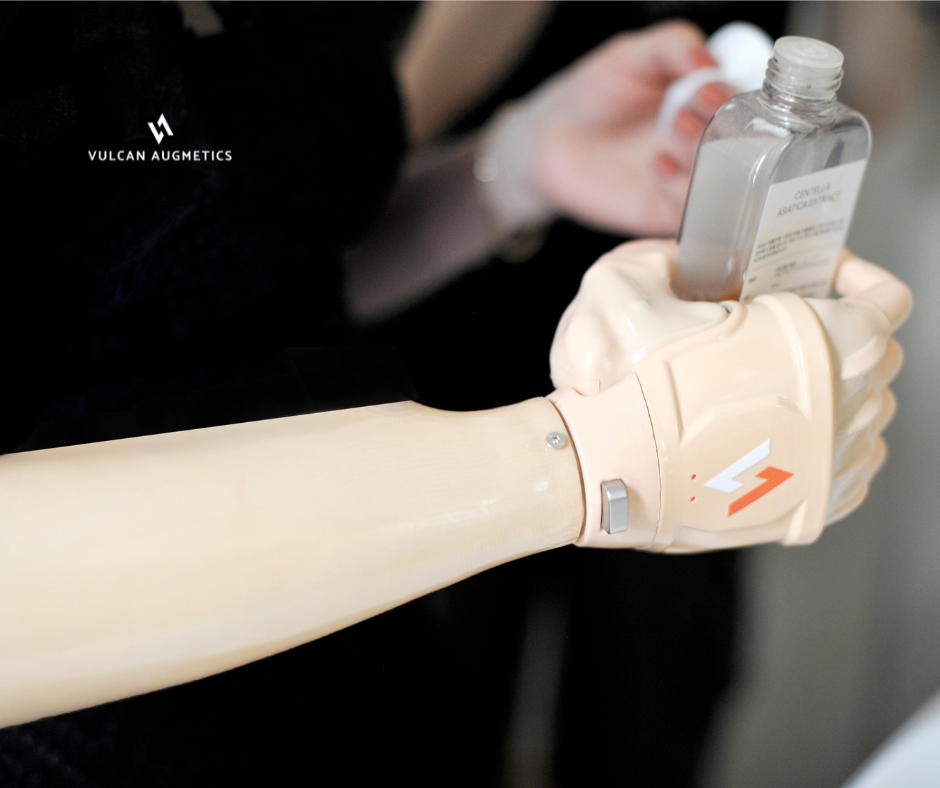
A powered hand often receives the most attention because it is the visible part of the prosthesis. Yet day-to-day control depends on the entire pathway between the user and the terminal device. Key elements include:
- The biological input: which muscle activity is available and can be reproduced intentionally.
- The sensing interface: how electrodes contact the skin and maintain access to the intended signal.
- Signal processing and calibration: how the system distinguishes a command from background activity and maps it to movement.
- The physical interface: the socket, liner, suspension, or external wearable that positions the sensing components.
- Powered components and communication: how the controller, battery, wrist, elbow, and terminal device exchange commands.
- Training and follow-up: how the user learns to generate repeatable inputs and incorporate the prosthesis into everyday tasks.
The VA/DoD upper-limb rehabilitation guideline similarly treats control strategy, socket interface, suspension, terminal device, wrist, elbow, and training as parts of a broader prescription and rehabilitation process. [2]
Myoelectric, body-powered, passive, and hybrid systems
Myoelectric control is one option within a larger range of upper-limb prosthetic approaches. Passive devices are generally positioned manually and may serve cosmetic, stabilizing, or task-specific purposes. Body-powered systems use body movement, a harness, and cables to operate a terminal device. Myoelectric systems use electrical muscle activity to control powered components. Hybrid configurations combine more than one control approach, often to manage multiple joints or balance system requirements. [1][2]
No category is automatically the best choice for every person or every task. Device selection and configuration depend on individual goals, anatomy, available control inputs, daily activities, maintenance considerations, and professional assessment. This article explains the technology category; it does not determine individual candidacy.
Where sensing architecture changes the workflow
Traditional myoelectric systems commonly place surface electrodes inside the socket so that they contact selected areas of the residual limb. This approach links signal acquisition closely to socket design, electrode placement, skin contact, and suspension. [1][2]
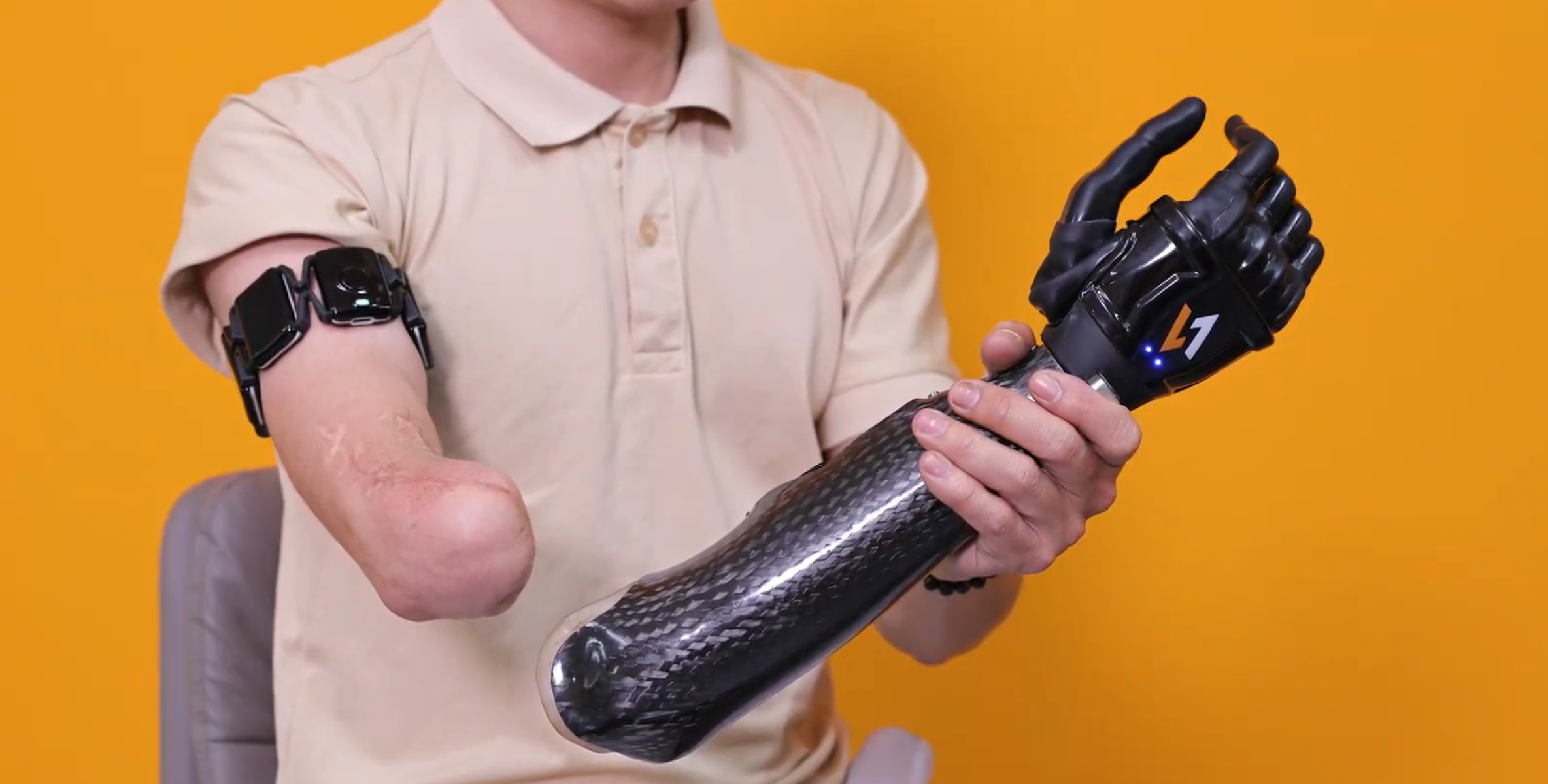
Wearable sensing architectures separate some of the sensing hardware from the socket. Instead of treating the electrode only as an embedded socket component, a wearable can capture muscle activity externally and transmit a processed command to a compatible prosthetic system. This does not remove the need for appropriate assessment, fitting, configuration, or training. It changes where sensing and communication occur within the system.
Vulcan Myoband: one example of a wearable control architecture
Vulcan Myoband is one example of an external wearable control architecture designed for integration with compatible upper-limb prosthetic systems. By positioning the sensing layer outside the socket, it offers a different approach to the relationship between signal acquisition, prosthetic fitting, and device integration.
The underlying principle remains the same: electrical activity generated by muscle contraction is detected and translated into a command for a powered prosthetic component.
What should teams evaluate in a myoelectric control system?
When reviewing a myoelectric solution, it is useful to look beyond the number of available grips or the appearance of the terminal device. Questions for technical and clinical discussion may include:
- Where and how are muscle signals acquired?
- How does the sensing interface interact with the socket or liner?
- What control strategy is used, and what calibration does it require?
- Which hands, wrists, elbows, or other components are confirmed as compatible?
- How are mode changes or unsuccessful commands communicated to the user?
- What training, follow-up, maintenance, and technical support are expected?
A system, not simply a powered hand
A myoelectric prosthesis turns voluntary muscle activity into commands for powered prosthetic components. The central idea is straightforward: detect an EMG signal, process it, map it to an action, and deliver the command to the device. What determines the real-world configuration is the system built around that pathway.
For CPOs, manufacturers, and rehabilitation teams, understanding that complete pathway makes it easier to evaluate where a control solution fits, what it requires, and how it should be discussed with users. Myoelectric technology is therefore best considered not as a single component, but as an interaction between the person, the sensing interface, the controller, and the prosthesis.
References
1. Iowa Health and Human Services, Myoelectric Prosthesis Upper Extremity (2024). View source
2. U.S. Department of Veterans Affairs / Department of Defense, Clinical Practice Guideline for the Management of Upper Limb Amputation Rehabilitation — Provider Summary (2022). View source
3. Yadav et al., Recent trends and challenges of surface electromyography in prosthetic applications, Biomedical Engineering Letters (2023). View source
4. Vulcan Augmetics, Vulcan Myoband Control Solution (2026).
Editorial note: This article is educational brand content. It does not provide medical advice, determine prosthetic candidacy, or claim clinical outcomes. Product configurations and compatibility should be confirmed against current approved documentation.
Educational content – not individual clinical guidance